

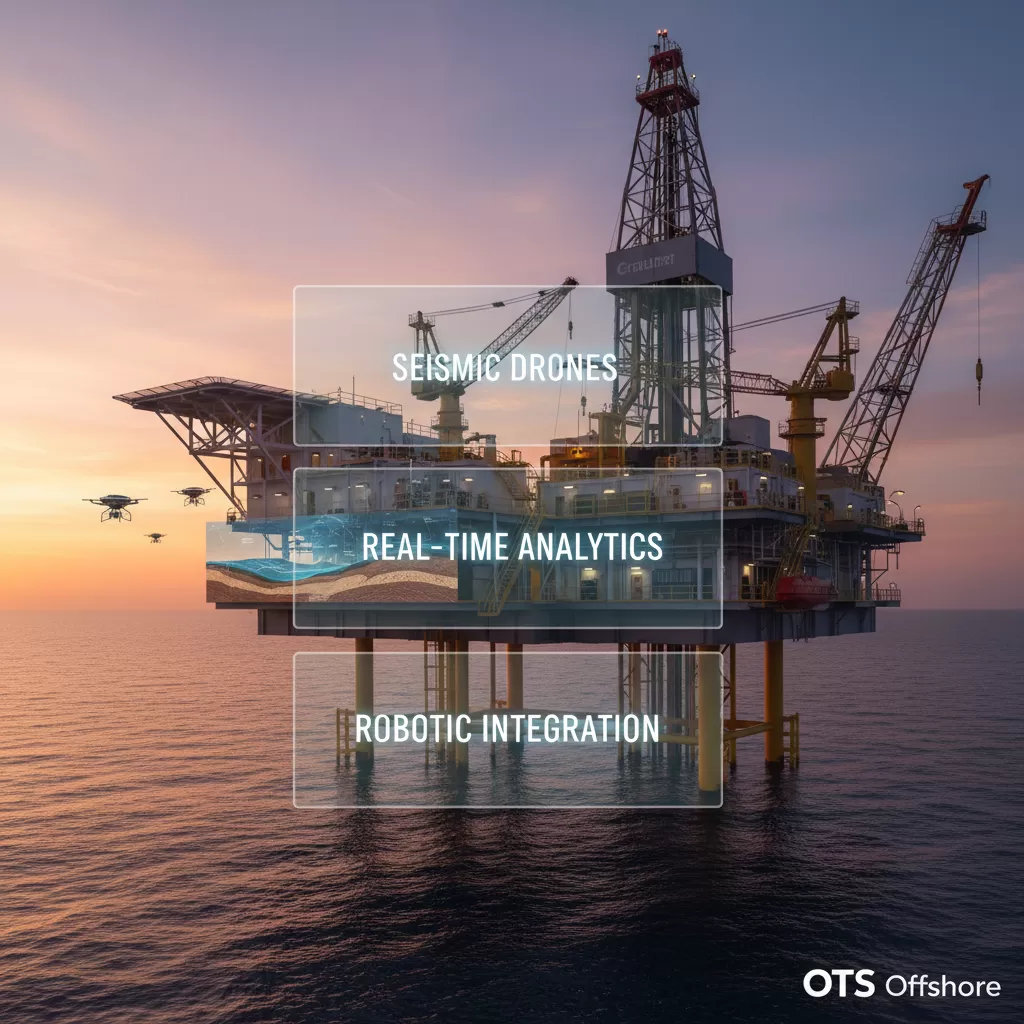
The integration of seismic survey technology with drilling platforms is revolutionizing offshore exploration and production, offering unparalleled efficiency and accuracy. This synergy allows for real-time data acquisition and analysis, significantly reducing exploration risks and optimizing drilling operations. This article delves into the technological advancements driving this integration and its profound implications for the future of the offshore energy sector.
The Future of Offshore: Integrating Seismic Survey Technology with Drilling Platforms
The offshore energy sector stands on the cusp of a transformative era, driven by the imperative to enhance exploration efficiency, mitigate risk, and optimize production in increasingly challenging environments. Central to this evolution is the concept of the Future Offshore: Integrating seismic survey technology directly with drilling platforms. This paradigm shift moves beyond conventional, separate workflows, enabling a seamless fusion of subsurface imaging and in-situ operational data. The implications for hydrocarbon discovery, reservoir characterization, and the overall economics of offshore projects are profound. By bringing seismic data acquisition and processing capabilities closer to the point of drilling, operators gain the ability to make more informed, data-driven decisions in near real-time. This allows for dynamic adjustments to drilling trajectories, well placement, and reservoir management strategies, directly addressing the inherent uncertainties and complexities of deepwater and frontier exploration. The pursuit of the Future Offshore: Integrating these critical technologies is not merely an incremental improvement; it represents a fundamental redefinition of how offshore energy resources are discovered and extracted.
Unveiling the Core Technologies Driving Future Offshore: Integrating
At the heart of the Future Offshore: Integrating seismic survey technology with drilling platforms lies a confluence of advanced technological developments. These innovations span across data acquisition, processing, and interpretation, all converging to create a more intelligent and responsive offshore operational environment. The ability to capture high-resolution seismic data instantaneously, coupled with sophisticated real-time processing algorithms, allows for an unprecedented understanding of the subsurface geology beneath the drilling rig.
– High-Density Seismic Acquisition Systems: Traditional seismic surveys involve dedicated vessels and towed streamers, creating a temporal and spatial disconnect from drilling operations. The Future Offshore: Integrating paradigm embraces technologies like node-based seismic acquisition, where autonomous, seabed-mounted sensors are deployed closer to the drill site. These nodes offer superior data quality and coverage, particularly in complex geological settings. Furthermore, advancements in ocean-bottom seismic (OBS) and ocean-bottom nodes (OBN) have enabled more precise imaging, capturing subtle geological features that might be missed by conventional methods. The proximity of these sensors to the drilling operation allows for a more direct correlation between seismic reflectors and actual drilling events.
– Real-Time Data Processing and Interpretation: The sheer volume of seismic data generated requires sophisticated processing capabilities. The Future Offshore: Integrating concept necessitates the deployment of powerful onboard processing units and cloud-based solutions capable of handling massive datasets. This includes advancements in seismic migration algorithms, full waveform inversion (FWI), and machine learning for automated interpretation. By processing data in near real-time, geoscientists and drilling engineers can identify potential drilling hazards, such as shallow gas pockets or overpressure zones, much earlier than in conventional workflows. This proactive approach significantly enhances safety and reduces the risk of non-productive time (NPT).
– Integrated Sensor Networks and Communication: The success of the Future Offshore: Integrating initiative hinges on the robust integration of diverse sensor networks. This includes seismic sensors, downhole logging tools, drilling parameters, and platform-based environmental monitoring systems. High-bandwidth, low-latency communication infrastructure, often utilizing satellite or fiber optic links, is crucial for transmitting this vast amount of data from the seabed and platform to processing centers, whether onshore or onboard. The seamless flow of information between these disparate systems creates a holistic view of the subsurface and the drilling operation.
– Advanced Reservoir Modeling and Simulation: The continuous influx of seismic and drilling data feeds directly into sophisticated reservoir modeling and simulation software. This allows for dynamic updating of reservoir models as drilling progresses, providing a more accurate representation of reservoir geometry, fluid distribution, and rock properties. The Future Offshore: Integrating approach enables iterative refinement of drilling plans and production strategies based on this evolving understanding, optimizing wellbore placement for maximum reservoir contact and improved recovery factors.
– Artificial Intelligence and Machine Learning Applications: AI and ML are pivotal to unlocking the full potential of the Future Offshore: Integrating. These technologies are employed for automated seismic interpretation, anomaly detection, predictive maintenance of equipment, and optimization of drilling parameters. Machine learning algorithms can identify complex patterns in seismic data that might be imperceptible to human interpreters, leading to the discovery of subtle stratigraphic traps or fractured reservoirs.

The Transformative Impact of Future Offshore: Integrating Seismic and Drilling
The adoption of the Future Offshore: Integrating seismic survey technology with drilling platforms promises a seismic shift in how offshore exploration and production are conducted. The benefits extend across multiple facets of the operational lifecycle, from initial exploration to ongoing production optimization.
– Enhanced Exploration Success Rates: By providing more accurate and timely subsurface imaging, the Future Offshore: Integrating approach significantly reduces the uncertainty associated with exploration wells. Geoscientists can better delineate prospect boundaries, assess reservoir quality, and identify potential drilling challenges before spudding the well. This leads to a higher probability of discovery and a more efficient allocation of exploration capital. The ability to perform pre-drill seismic surveys with higher resolution and integrate the findings directly into the drilling plan minimizes the guesswork involved.
– Optimized Drilling Operations and Reduced Non-Productive Time (NPT): The real-time insights gained from integrated seismic and drilling data enable proactive decision-making. Potential drilling hazards can be identified and mitigated before they cause costly delays. For instance, detecting shallow gas zones or unstable formations allows for the adjustment of drilling fluid properties, casing points, or drilling speeds, thereby preventing blowouts or wellbore collapses. This direct correlation between seismic interpretation and drilling execution is a cornerstone of the Future Offshore: Integrating value proposition.
– Improved Reservoir Characterization and Development: The continuous flow of data from seismic surveys and downhole tools allows for an unprecedented level of reservoir characterization. Subtle stratigraphic features, fracture networks, and fluid contacts can be identified with greater precision. This detailed understanding is critical for optimizing well placement, designing effective completion strategies, and maximizing hydrocarbon recovery. The Future Offshore: Integrating methodology supports iterative refinement of reservoir models, leading to more targeted and efficient field development.
– Increased Safety and Environmental Stewardship: By identifying and mitigating potential drilling hazards early, the Future Offshore: Integrating approach significantly enhances operational safety. This includes the detection of geohazards like seabed instability or the presence of shallow gas. Furthermore, more efficient exploration and development lead to a reduced footprint and a more judicious use of resources, contributing to enhanced environmental stewardship in offshore operations.
– Economic Advantages and Cost Reduction: The cumulative effect of improved exploration success, reduced NPT, optimized drilling, and enhanced reservoir recovery translates directly into significant economic benefits. By minimizing risks and maximizing efficiency, companies can achieve higher rates of return on their offshore investments. The Future Offshore: Integrating concept helps to de-risk capital expenditure and improve the overall profitability of offshore projects.
Navigating the Challenges of Future Offshore: Integrating Seismic and Drilling
While the promise of the Future Offshore: Integrating seismic survey technology with drilling platforms is immense, its widespread adoption is not without its challenges. Overcoming these hurdles is crucial for unlocking the full potential of this transformative approach.
– Data Integration and Interoperability: A key challenge lies in effectively integrating vast and diverse datasets from various sources, including seismic sensors, drilling equipment, and logging tools. Ensuring seamless interoperability between different software platforms and hardware systems is paramount. Establishing standardized data formats and robust data management protocols is essential for enabling real-time data flow and analysis. The success of the Future Offshore: Integrating paradigm hinges on breaking down data silos.
– Computational Power and Infrastructure: Processing and analyzing the massive amounts of seismic data in near real-time requires significant computational power and advanced infrastructure. This includes investing in high-performance computing clusters, sophisticated data storage solutions, and reliable communication networks. Ensuring that this infrastructure can be deployed and maintained in remote offshore environments presents its own set of logistical and technical complexities.
– Skillset and Workforce Development: The effective implementation of the Future Offshore: Integrating approach requires a highly skilled workforce with expertise in seismic data processing, interpretation, data analytics, AI/ML, and petroleum engineering. Upskilling existing personnel and attracting new talent with these specialized skills will be crucial for the successful adoption and advancement of this technology.
– Cost of Implementation: The initial investment in advanced seismic acquisition systems, processing hardware, and software can be substantial. Companies need to carefully evaluate the return on investment and the long-term economic benefits to justify these upfront costs. However, the potential for cost savings through reduced NPT and improved efficiency often outweighs the initial investment.
– Regulatory and Permitting Frameworks: Evolving regulatory landscapes may need to adapt to the new operational paradigms introduced by the Future Offshore: Integrating. Ensuring that existing regulations adequately address the safety and environmental aspects of these integrated technologies, and that permitting processes are streamlined, will be important for facilitating adoption.

The Evolving Landscape of Offshore Exploration and Production
The trajectory of the offshore energy sector is increasingly defined by innovation and adaptation. The Future Offshore: Integrating seismic survey technology with drilling platforms represents a significant leap forward, promising a more efficient, safer, and economically viable future for hydrocarbon exploration and production. As technology continues to advance and computational capabilities expand, the synergy between seismic data and drilling operations will only deepen. This integrated approach is not just a technological upgrade; it’s a fundamental shift in mindset, emphasizing real-time intelligence and data-driven decision-making. The industry’s ability to embrace and effectively implement these integrated solutions will be a key determinant of its success in meeting global energy demands while navigating the complexities of the modern energy landscape. The pursuit of the Future Offshore: Integrating seismic with drilling is an ongoing journey of innovation, pushing the boundaries of what is possible in the challenging and dynamic offshore environment.