


Here’s the article written to your specifications, focusing on the technical aspects of oil and gas infrastructure maintenance.
Case Study: Inspection and Repair of Internal Tower Ladders and Platforms
This case study details the critical process of inspecting and repairing internal tower ladders and platforms within oil and gas facilities. It highlights the inherent risks, essential methodologies, and the vital role of proactive maintenance in ensuring operational safety and structural integrity. This examination delves into the challenges faced and the solutions implemented to mitigate potential hazards, underscoring the significance of rigorous inspection protocols.
The Imperative of Case Study: Inspection for Internal Tower Access Systems
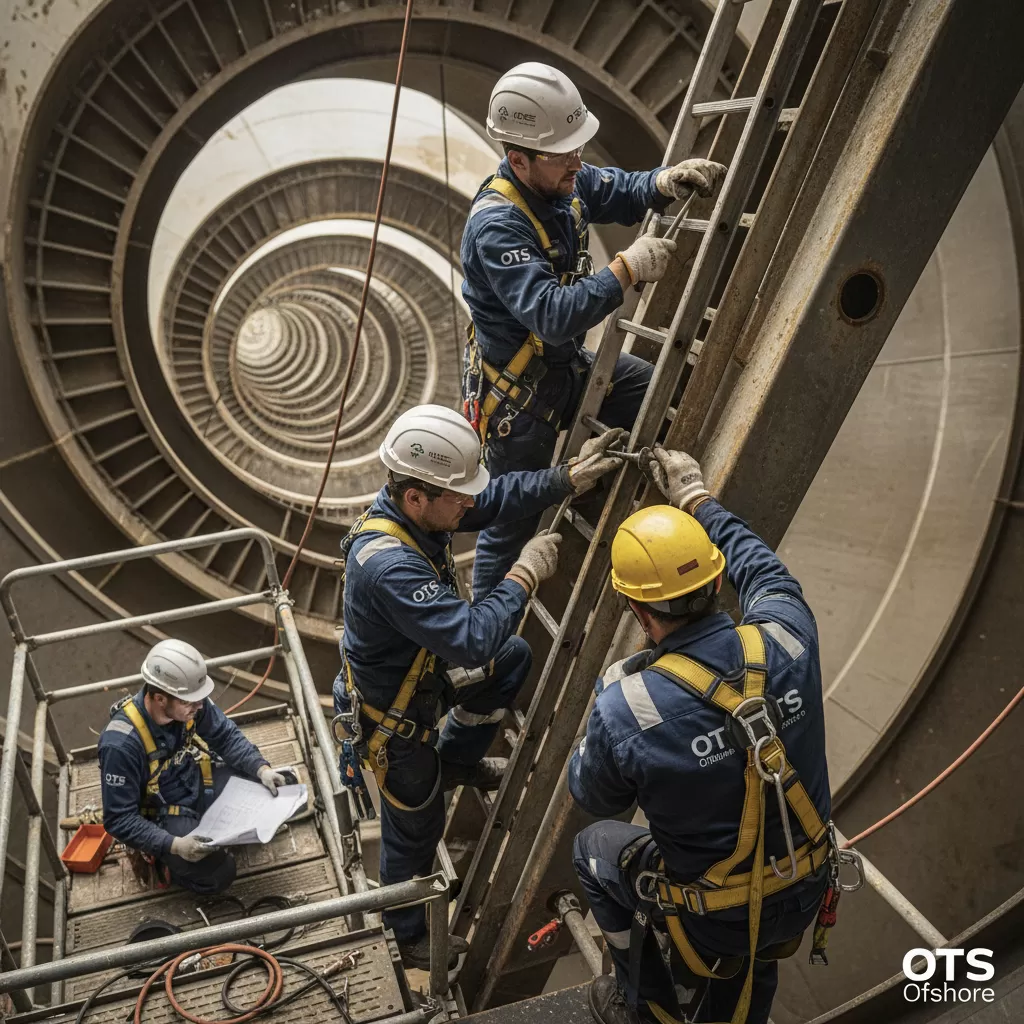
In the demanding environment of oil and gas operations, the integrity of every component is paramount. Internal tower ladders and platforms, while often overlooked, are critical access points that bear significant structural load and are exposed to corrosive elements and demanding operational cycles. A thorough Case Study: Inspection is not merely a procedural checkbox; it is a fundamental element of risk management and operational continuity. These systems provide essential vertical and horizontal mobility for personnel conducting inspections, maintenance, and emergency response within complex process structures. Their failure can lead to catastrophic accidents, resulting in severe injuries, fatalities, and substantial operational downtime. Therefore, understanding the methodologies and outcomes of a comprehensive Case Study: Inspection becomes indispensable for plant managers, safety officers, and maintenance engineers. This document aims to provide an in-depth analysis of a typical inspection and repair scenario, emphasizing best practices and lessons learned.
Understanding the Risks Associated with Tower Access Systems
The operational environment of oil and gas facilities presents unique challenges that directly impact the longevity and safety of internal tower ladders and platforms. Exposure to a wide array of corrosive agents, including hydrocarbons, acidic compounds, and saline moisture, accelerates material degradation. The constant thermal cycling, from extreme heat during process operations to ambient temperature fluctuations, induces material stress and fatigue. Furthermore, mechanical wear and tear from regular foot traffic, the movement of tools and equipment, and potential impact loads contribute to the deterioration of structural elements.
– Material corrosion: This is perhaps the most pervasive threat, leading to thinning of structural members, weakening of welds, and compromised load-bearing capacity. Different materials used in construction, such as carbon steel, stainless steel, and aluminum alloys, exhibit varying degrees of susceptibility to specific corrosive agents found in process environments.
– Structural fatigue: Repeated stress cycles, especially around connection points, welds, and ladder rungs, can lead to the formation and propagation of cracks, ultimately resulting in structural failure.
– Environmental degradation: Exposure to UV radiation, humidity, and extreme temperatures can degrade protective coatings, making the underlying metal more vulnerable to corrosion.
– Human error during maintenance: Inadequate repair procedures, improper material selection, or insufficient quality control during maintenance activities can inadvertently weaken the structure, creating new hazards.
– Operational impact: Vibrations from nearby equipment, accidental impacts during material handling, or overloading of platforms can all contribute to premature wear and potential failure.
Key Components of a Robust Case Study: Inspection Program
A comprehensive Case Study: Inspection program for internal tower ladders and platforms requires a systematic and multi-faceted approach. It moves beyond simple visual checks to encompass detailed structural assessments, material analysis, and the application of advanced non-destructive testing (NDT) techniques. The goal is to identify potential defects, assess their severity, and determine the remaining service life of the components.
– Initial visual examination: This fundamental step involves a meticulous walk-through of the entire ladder and platform system. Inspectors look for obvious signs of damage, such as visible corrosion, cracks, deformation, loose fasteners, missing rungs, or damaged tread surfaces. Special attention is paid to areas of high stress, such as weld joints and connection points.
– Detailed structural integrity assessment: This involves measuring critical dimensions, checking for any out-of-plumb or twisted members, and verifying that all components are securely fastened. Load-bearing elements, including stringers, treads, risers, and platform beams, are scrutinized for signs of thinning or excessive deformation.
– Non-destructive testing (NDT) methods: To uncover subsurface defects that are not visible to the naked eye, NDT techniques are employed.
– Ultrasonic Testing (UT): This method uses sound waves to detect internal flaws like cracks, voids, and inclusions in metal components. It is particularly effective in determining material thickness and identifying areas of significant corrosion.
– Magnetic Particle Testing (MT): This technique is used to detect surface and near-surface discontinuities in ferromagnetic materials. It involves magnetizing the component and then applying magnetic particles, which will accumulate at areas of flux leakage caused by defects.
– Dye Penetrant Testing (PT): This method is used to detect surface-breaking defects like cracks and porosity. A liquid penetrant is applied to the surface, seeps into any discontinuities, and then a developer is applied to draw the penetrant out, making the flaw visible.
– Eddy Current Testing (ECT): This electromagnetic testing method is used to detect surface and near-surface cracks, as well as measure coating thickness and material properties.
– Material analysis: In cases of significant corrosion or suspected material degradation, samples may be taken for laboratory analysis to determine the specific type of corrosion, the extent of material loss, and the remaining mechanical properties of the metal. This can inform decisions about the appropriate repair methods and the selection of suitable replacement materials.
– Review of historical data: Previous inspection reports, maintenance logs, and any records of previous repairs are crucial for understanding the long-term behavior of the structure and identifying recurring issues. This historical perspective is vital for developing effective predictive maintenance strategies.
1. Implementing Advanced NDT Techniques for Deeper Insights
The efficacy of any Case Study: Inspection program hinges on the appropriate selection and skillful application of Non-Destructive Testing (NDT) methods. Traditional visual inspections, while essential, are limited in their ability to detect internal defects or the full extent of subsurface corrosion. Advanced NDT techniques provide a more comprehensive understanding of the structural health of internal tower ladders and platforms, enabling the early detection of potential failure points.
– Ultrasonic Testing (UT) for Thickness Measurement and Flaw Detection: UT is a cornerstone of modern structural inspection. By transmitting high-frequency sound waves into the material and analyzing the reflected echoes, inspectors can accurately determine the thickness of metal components, identifying areas where corrosion has thinned the material. UT can also detect internal flaws such as laminations, voids, and cracks that are not visible on the surface. This is particularly valuable for assessing the integrity of thicker structural members and welds within platforms and ladder stringers. Automated UT (AUT) systems can further enhance efficiency and data acquisition for large structures.
– Magnetic Particle Testing (MT) for Surface and Near-Surface Defects: For ferromagnetic materials commonly used in oil and gas infrastructure, MT is an invaluable technique for identifying surface and near-surface cracks, seams, and laps. The process involves magnetizing the component and then applying fine magnetic particles. These particles are attracted to areas of magnetic flux leakage, which are indicative of surface or subsurface discontinuities. MT is highly sensitive to fine cracks that might be missed by visual inspection.
– Dye Penetrant Testing (PT) for Surface-Breaking Flaws: PT is a straightforward yet effective method for revealing surface-breaking defects such as cracks, porosity, and seams. After cleaning the surface, a colored or fluorescent penetrant is applied and allowed to dwell, enabling it to seep into any discontinuities. Excess penetrant is removed, and a developer is applied, which draws the trapped penetrant out, making the flaw visible as a colored line or spot. PT is particularly useful for inspecting welds and smaller components where UT or MT might be less practical.
– Eddy Current Testing (ECT) for Surface Integrity and Material Characterization: ECT utilizes electromagnetic induction to detect surface and near-surface flaws in conductive materials. By inducing eddy currents in the material and monitoring their response to surface discontinuities or variations in material properties, ECT can identify cracks, measure coating thickness, and even assess hardness. This technique is sensitive and can be applied at relatively high speeds, making it suitable for inspecting large surface areas of platforms and ladder rungs.
2. Prioritizing Repair Strategies Based on Risk Assessment
Once an inspection is complete and any identified defects are assessed, a prioritized repair strategy must be developed. This strategy should be directly informed by a comprehensive risk assessment, considering the severity of the defect, its location, the load-bearing function of the affected component, and the potential consequences of failure. The aim is to address the most critical issues first, ensuring that the operational safety of the tower access system is maintained.
– Immediate repair for critical defects: Defects that pose an imminent risk of structural failure, such as major cracks in primary load-bearing members, significant section loss due to corrosion, or complete loss of weld integrity, require immediate attention. These repairs might involve temporary shoring, partial or full replacement of the affected section, or significant structural reinforcement.
– Planned repairs for moderate defects: Less critical defects, such as localized corrosion pitting, minor surface cracks that have not significantly reduced material thickness, or loose fasteners, can be addressed through planned maintenance activities. This allows for efficient scheduling, resource allocation, and minimizes disruption to ongoing operations. Repairs might include surface preparation and application of specialized coatings, welding of reinforcing patches, or tightening/replacement of fasteners.
– Monitoring and preventative measures for minor defects: Small defects, such as minor surface abrasions or slight surface rust that does not compromise structural integrity, may be managed through a program of increased monitoring and preventative maintenance. This could involve more frequent visual inspections, application of protective coatings, and addressing minor surface issues before they escalate.
– Material selection for repairs: A crucial aspect of any repair is the selection of appropriate materials. Replacement parts or welding consumables should be compatible with the original material and designed to withstand the specific corrosive and mechanical conditions of the operating environment. Using substandard or incompatible materials can lead to premature failure of the repair itself.
3. The Role of Advanced Materials and Coatings in Longevity
The longevity and resilience of internal tower ladders and platforms are significantly enhanced by the judicious application of advanced materials and protective coatings. Beyond basic structural integrity, these elements play a crucial role in mitigating the pervasive threat of corrosion and wear, thereby extending the service life of these critical access systems. A proactive approach incorporating these technologies can dramatically reduce the frequency and cost of future repairs.
– High-performance coatings: Modern industrial coatings offer superior protection against a wide range of corrosive agents and environmental factors.
– Epoxy coatings: These are widely used due to their excellent adhesion, chemical resistance, and durability. They provide a robust barrier against hydrocarbons, acids, and moisture.
– Polyurethane coatings: Known for their flexibility, abrasion resistance, and UV stability, polyurethanes are ideal for surfaces subjected to mechanical wear and outdoor exposure.
– Zinc-rich primers: These provide sacrificial protection by allowing the zinc to corrode preferentially, protecting the underlying steel. They are often used as a first layer in multi-coat systems.
– Specialized anti-corrosion coatings: For extremely aggressive environments, advanced coatings incorporating ceramic fillers, fluoropolymers, or other high-performance resins may be employed to offer enhanced chemical resistance and extreme temperature tolerance.
– Advanced structural materials: While traditional carbon steels remain common, the consideration of more resilient materials for critical components or in highly corrosive environments is increasingly important.
– Stainless steel: Offers superior corrosion resistance compared to carbon steel, especially in environments with chlorides or acidic compounds. However, its higher cost can be a limiting factor.
– Galvanized steel: Provides a sacrificial zinc coating that offers good corrosion protection for moderate environments. Hot-dip galvanizing ensures a thorough and durable coating.
– Aluminum alloys: Lightweight and corrosion-resistant, certain aluminum alloys can be suitable for specific applications, though their strength characteristics need careful consideration for load-bearing structures.
– Composite materials: In niche applications, fiber-reinforced polymer (FRP) composites are being explored for ladders and platforms. These materials offer excellent corrosion resistance, high strength-to-weight ratios, and are non-conductive. However, their application in high-temperature or high-impact environments requires careful evaluation.
4. Documenting and Analyzing Case Study: Inspection Outcomes for Continuous Improvement
Effective documentation and rigorous analysis of Case Study: Inspection outcomes are the bedrock of a continuously improving maintenance and safety program. Each inspection, repair, and subsequent performance monitoring provides valuable data that informs future decisions, refines maintenance strategies, and ultimately enhances operational safety and efficiency. The insights gained from these documented experiences are crucial for preventing recurring issues and optimizing resource allocation.
– Comprehensive inspection reports: Detailed records of each inspection are essential. These reports should include:
– Dates of inspection and names of inspectors.
– Visual findings with photographic evidence of any defects.
– Results of all NDT conducted, including specific readings and interpretations.
– Measurements of material thickness and any identified section loss.
– Identification of any deviations from design specifications or previous conditions.
– Recommendations for repair, replacement, or further monitoring.
– Repair documentation: Following any repair work, thorough documentation is critical. This includes:
– Details of the work performed, including specific procedures followed.
– Materials used for repairs, including grade, manufacturer, and certification.
– Welder qualifications and welding procedures employed.
– Post-repair inspections and testing to verify the integrity of the repair.
– Before-and-after photographic records.
– Trend analysis and predictive maintenance: The true power of Case Study: Inspection lies in the analysis of aggregated data over time. By tracking the progression of corrosion, the frequency of defects, and the effectiveness of various repair strategies, maintenance teams can:
– Identify areas or components that are prone to specific types of degradation.
– Forecast potential future failures based on observed trends.
– Optimize inspection schedules, focusing resources on higher-risk areas.
– Develop more effective preventative maintenance strategies.
– Justify investments in more robust materials or preventative coating systems.
– Lessons learned and knowledge sharing: Each Case Study: Inspection and subsequent repair effort presents an opportunity for learning. Documenting lessons learned, particularly regarding unexpected findings, challenges encountered during repairs, or the performance of specific materials and coatings, is vital. This knowledge should be shared within the organization to foster a culture of continuous improvement and to prevent the repetition of past mistakes. This knowledge sharing is critical for training new personnel and ensuring that best practices are consistently applied across all facilities.