

Changing the number of poles in asynchronous generators is a critical strategy for fine-tuning rotational speed, particularly in applications where variable energy sources like wind and hydro power are harnessed. This technique offers a sophisticated method to adapt generator output to fluctuating input speeds, thereby optimizing energy conversion efficiency and grid stability. This article delves into the technical nuances, operational advantages, and challenges associated with modifying pole configurations in asynchronous generators for precise rotational speed adjustment within the oil and gas and broader energy sectors.
The Impact of Changing Number Poles on Asynchronous Generator Performance
Changing the number of poles in an asynchronous generator is a fundamental method for altering its synchronous speed, and consequently, its operational rotational speed range. This is not a trivial modification but rather a design or operational consideration that directly influences the generator’s electromagnetic characteristics and its ability to convert mechanical energy into electrical energy across a spectrum of prime mover speeds. The relationship between the number of poles (p), the synchronous speed (ns), and the grid frequency (f) is governed by the equation ns = (120 * f) / p. Therefore, increasing the number of poles will decrease the synchronous speed, and conversely, decreasing the number of poles will increase it. This principle is central to optimizing energy capture from variable speed sources.
Understanding the Fundamentals of Asynchronous Generators
An asynchronous generator, also known as an induction generator, operates on the principle of electromagnetic induction. Unlike synchronous generators, its rotor speed does not necessarily match the synchronous speed dictated by the magnetic field created by the stator winding. The rotor must spin at a speed slightly faster than the synchronous speed for the generator to produce power. This difference in speed, known as slip, is essential for inducing current in the rotor and generating torque. The stator winding, when connected to an AC power source, creates a rotating magnetic field whose speed is determined by the frequency of the power source and the number of pole pairs in the winding. The number of poles directly dictates the speed of this rotating magnetic field.
– The stator winding configuration determines the number of magnetic poles.
– The rotating magnetic field’s speed is called synchronous speed.
– The rotor’s speed must exceed synchronous speed for power generation.
– Slip is the difference between synchronous speed and rotor speed.
The Role of Pole Numbers in Synchronous Speed
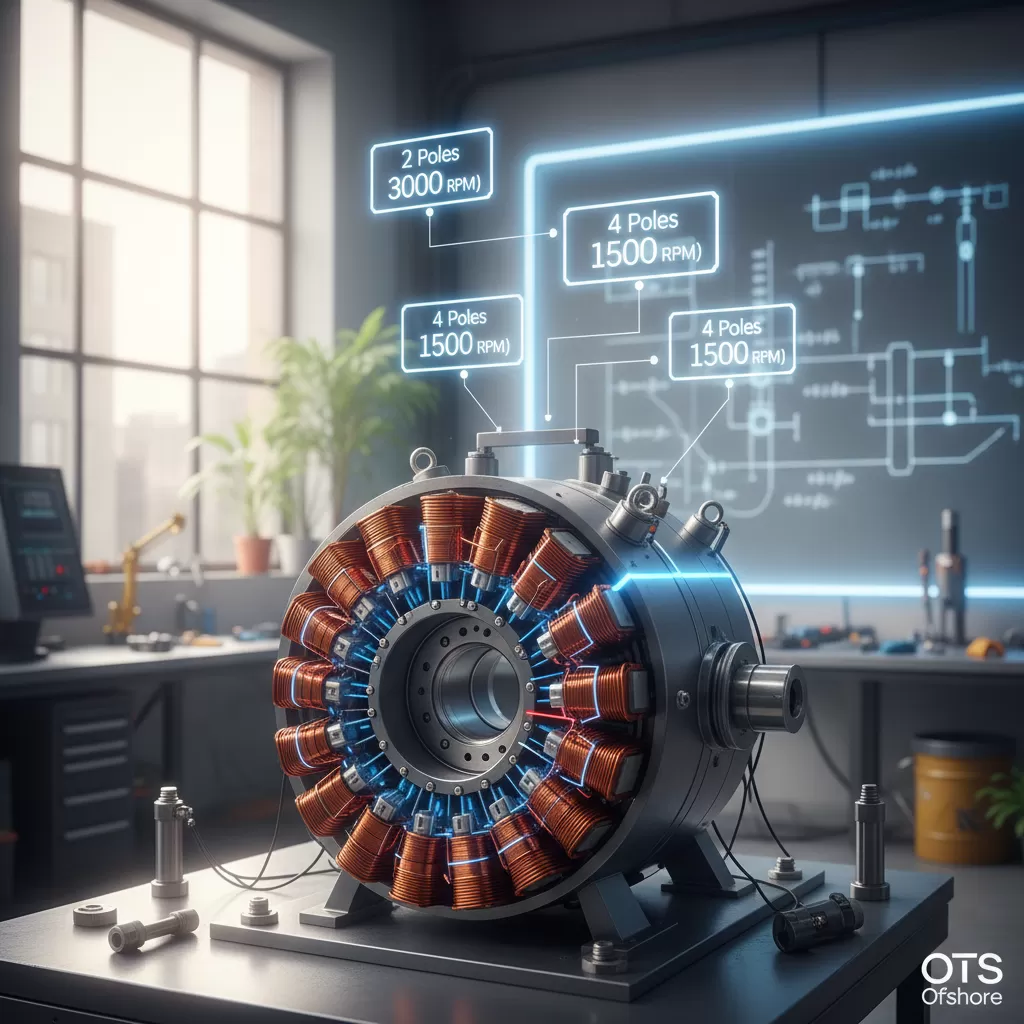
The synchronous speed (ns) of the rotating magnetic field is inversely proportional to the number of poles (p). A generator with fewer poles will have a higher synchronous speed for a given frequency, while a generator with more poles will have a lower synchronous speed. For instance, a two-pole generator operating at 60 Hz has a synchronous speed of 3600 RPM, whereas a four-pole generator at the same frequency has a synchronous speed of 1800 RPM. This fundamental relationship is the basis for altering the operational speed characteristics of the generator. In applications with widely varying prime mover speeds, such as wind turbines where wind velocity fluctuates, being able to adjust the generator’s operating speed range is crucial for maximizing energy capture.
Methods for Changing the Number of Poles
The practical implementation of changing the number of poles in an asynchronous generator can be achieved through several approaches, each with its own complexities and suitability for different applications. The most common methods involve reconfiguring the stator windings.
Stator Winding Reconfiguration
This is the most direct method for changing the pole number. It involves designing the stator winding such that it can be physically reconnected to form different numbers of poles. This is typically achieved through the use of multi-winding configurations or by strategically placed taps within the windings.
– Multiple independent windings can be connected in series or parallel to create different pole configurations.
– Damper windings or squirrel cage rotors are common in asynchronous generators, and their design must be compatible with the chosen stator pole configuration.
– The switching mechanism to change the pole configuration needs to be robust and reliable, especially in harsh environments common in the energy sector.
Dual-Speed or Multi-Speed Generators
Some generators are specifically designed with the capability to operate at two or more distinct speeds by having windings that can be switched to create different pole numbers. This is often a feature of larger industrial machines, particularly those used in variable speed applications.
– These generators are built with segmented stator windings.
– External control systems are used to switch between pole configurations, often while the generator is offline or under controlled conditions.
– The design accounts for the additional complexity and cost associated with multi-speed operation.
Variable Frequency Drives (VFDs) and Pole Number Changes
While VFDs are primarily used to control the speed of induction motors by varying the frequency of the power supplied, they can also interact with asynchronous generators. In some advanced configurations, the VFD can be used in conjunction with a generator that has the inherent capability to change its pole number. The VFD can then provide a more seamless transition between speeds and optimize the generator’s performance at each pole configuration. However, it is important to note that a standard asynchronous generator’s speed is intrinsically linked to its pole number and frequency. Changing the number of poles is a physical modification of the machine itself, not just a control parameter.
Technical Considerations and Challenges
Implementing changes to the number of poles in an asynchronous generator is not without its technical hurdles. Careful design and engineering are required to ensure optimal performance and longevity.
Electromagnetic Design Implications
Changing the number of poles alters the magnetic flux distribution within the generator. This can affect the torque-speed characteristics, efficiency, and power factor.
– A higher number of poles generally leads to lower synchronous speed but can also result in a lower power density and increased core losses.
– The rotor design, especially for squirrel cage rotors, needs to be optimized for the intended range of operating speeds and pole configurations.
– Harmonic content in the generated voltage and current can change, which may require additional filtering or conditioning for sensitive grid connections.
Mechanical and Thermal Stresses
Switching between pole configurations can introduce transient mechanical stresses and thermal variations. The switching mechanism itself must be designed to handle the electrical currents and potential arcing.
– The insulation systems must be robust enough to withstand the electrical stresses associated with different winding configurations and switching operations.
– Thermal management becomes more complex as different operating points will have varying heat dissipation requirements.
– Vibration analysis is crucial, as changes in rotational speed can excite different mechanical resonant frequencies.
Control Systems and Grid Integration
Integrating generators with variable pole numbers into the power grid requires sophisticated control systems. These systems must manage the switching process, ensure synchronization, and maintain power quality.
– Synchronization procedures become more complex when changing pole numbers.
– The control system needs to be aware of the current pole configuration and adjust parameters accordingly.
– Grid code compliance is essential, especially regarding voltage and frequency stability during and after pole changes.
Applications in the Oil and Gas and Energy Sectors
The ability to adjust rotational speed through changing the number of poles offers significant advantages in various energy-related industries.
Wind Energy Conversion
Wind turbines often operate with variable wind speeds, which translate to variable rotational speeds of the rotor. Asynchronous generators are widely used in wind energy systems. By enabling pole number changes, the generator can be optimized to operate efficiently across a broader range of wind conditions.
– Older fixed-speed wind turbine designs sometimes employed dual-speed generators to offer a limited range of operational speeds.
– Modern variable-speed wind turbines often use power electronic converters, but for specific applications, mechanical pole switching can still be a viable or supplementary solution.
– This allows for increased energy capture and improved capacity factor.
Hydroelectric Power Generation
Hydropower plants, especially those utilizing Francis or Kaplan turbines, can experience fluctuations in water flow and head. Asynchronous generators with selectable pole numbers can be employed to adapt to these variations, maximizing power output.
– Different turbine designs have optimal operating speed ranges.
– Changing the pole number allows the generator to better match the turbine’s speed across different operating conditions.
– This improves the overall efficiency of the hydroelectric plant.
Industrial Drives and Pumping Applications
In the oil and gas industry, large pumps and compressors often require variable speed operation. Asynchronous motors are common, and when used in reverse as generators (e.g., in systems with regenerative braking or pressure recovery), the principles of pole number changes for speed adjustment also apply.
– Optimizing pump speed reduces energy consumption and wear and tear.
– In processes involving pressure differentials, generating power through regeneration becomes more efficient with speed control.
– This leads to significant operational cost savings and improved process control.
Emerging Applications and Future Trends
As the demand for renewable energy and efficient industrial processes grows, the techniques for controlling generator speeds will continue to evolve. While power electronics offer a high degree of flexibility, mechanical pole switching, when integrated with advanced control strategies, may still play a role in specialized applications due to its robustness and potentially lower cost in certain scenarios. Research into novel winding configurations and more efficient switching mechanisms is ongoing. The focus remains on maximizing energy conversion efficiency, reducing mechanical stress, and ensuring seamless integration with the electrical grid. The ability to adapt to changing operational demands is paramount for future energy systems.