

Managing vibration and noise emissions offshore is crucial for environmental protection, operational efficiency, and regulatory compliance. This article delves into the complexities of controlling these disturbances in the offshore oil and gas industry, exploring advanced techniques and best practices to meet stringent international and national standards.
Strategies for Managing Vibration and Noise Emissions Offshore for Regulatory Compliance
The offshore energy sector operates under intense scrutiny regarding its environmental impact. Vibration and noise generated by a myriad of equipment, from powerful drilling rigs to processing facilities and subsea infrastructure, pose significant challenges. Effective Managing Vibration Noise is not merely an operational consideration but a critical component of ensuring long-term sustainability and adherence to a growing body of environmental regulations. These regulations, often driven by concerns for marine life, worker safety, and community well-being, necessitate a proactive and sophisticated approach to noise and vibration abatement. The challenge lies in mitigating these emissions without compromising the efficiency and integrity of offshore operations. This requires a deep understanding of the sources of vibration and noise, their propagation paths, and the implementation of robust control measures throughout the lifecycle of offshore installations.
The Critical Role of Managing Vibration Noise in Offshore Operations
Managing Vibration Noise in offshore environments is paramount for a multitude of reasons, extending beyond simple operational comfort. The persistent hum of generators, the percussive impact of drilling, and the resonant frequencies of rotating machinery can propagate through the platform structure and into the surrounding marine environment. This has direct implications for regulatory compliance. International bodies and national maritime administrations have established stringent limits on noise and vibration levels to protect sensitive marine ecosystems, particularly cetaceans, which rely heavily on acoustic cues for communication, navigation, and foraging. Exceeding these limits can result in substantial fines, operational stoppages, and reputational damage. Furthermore, excessive vibration can lead to structural fatigue, reduced equipment lifespan, and increased maintenance costs. It can also impair the accuracy of sensitive instrumentation, leading to operational inefficiencies and potential safety hazards. Therefore, a comprehensive strategy for Managing Vibration Noise is an indispensable element of responsible offshore energy development.
Understanding the Sources of Offshore Vibration and Noise
A thorough understanding of the primary sources of vibration and noise offshore is the foundational step in developing effective mitigation strategies. These sources are diverse and often interconnected, originating from both topside and subsea equipment.
– Topsides equipment: This category encompasses a wide range of machinery critical to the functionality of an offshore platform.
– Rotating machinery: Pumps, compressors, turbines, generators, and thrusters are significant contributors due to their inherent imbalances and operating speeds. Their rotational dynamics generate both structural vibration and airborne noise.
– Reciprocating machinery: Diesel engines and certain types of compressors produce distinct vibrational patterns and distinct acoustic signatures due to their cyclical combustion and piston movements.
– Impact sources: Drilling operations, particularly the hammer effect and drill string vibrations, can generate intense, transient noise and vibration. Pile driving during platform installation is another significant, albeit temporary, source.
– Fluid systems: High-pressure fluid flow in pipelines, valves, and risers can induce flow-induced vibration and noise, often exacerbated by turbulence and cavitation.
– HVAC systems: Ventilation fans, air handling units, and associated ductwork are common sources of low-frequency noise and vibration that can propagate throughout the platform.
– Subsea equipment: The underwater environment presents unique challenges for noise and vibration control.
– ROV and AUV operations: The propellers and power systems of remotely operated vehicles and autonomous underwater vehicles can generate acoustic emissions that affect marine life.
– Seismic exploration: Air guns used in seismic surveys produce powerful underwater acoustic pulses, a known source of significant environmental concern.
– Pipeline and riser vibrations: Flow-induced vibrations, vortex shedding, and internal pressure fluctuations in subsea pipelines and risers can generate acoustic energy.
– Subsea processing equipment: Pumps, compressors, and other processing units deployed on the seabed can be sources of both vibration and acoustic emissions.
Regulatory Frameworks Governing Offshore Noise and Vibration
The increasing awareness of the environmental impact of offshore activities has led to the development of comprehensive regulatory frameworks worldwide. These frameworks are designed to protect both the marine environment and human health and safety.
– International Maritime Organization (IMO): While not exclusively focused on offshore energy, the IMO sets global standards for noise and vibration control on vessels, which can influence offshore platform design and operation.
– International Council for the Exploration of the Sea (ICES): ICES provides scientific advice on the impacts of human activities on the marine environment, including noise pollution, which informs regulatory decisions.
– Regional Seas Conventions: Various regional agreements, such as the OSPAR Convention for the Protection of the Marine Environment of the North-East Atlantic, set specific environmental targets and recommend best practices for offshore industries.
– National Regulations: Individual countries with significant offshore energy sectors have their own detailed regulations. For example, the United States Environmental Protection Agency (EPA) and various state agencies, as well as the Bureau of Ocean Energy Management (BOEM), set standards for noise and vibration emissions. The UK’s Joint Nature Conservation Committee (JNCC) also plays a significant role in advising on marine noise. These regulations often specify maximum permissible noise levels, define monitoring requirements, and mandate the use of best available techniques (BAT) for noise reduction.

Advanced Techniques for Managing Vibration Noise Offshore
Effective Managing Vibration Noise offshore requires a multi-faceted approach, integrating engineering design, operational procedures, and advanced mitigation technologies. The goal is to minimize the generation of vibration and noise at the source, control its transmission, and, where necessary, implement abatement measures.
Source Control Measures
The most effective strategy for Managing Vibration Noise is to address it at its origin. This involves careful selection and design of equipment.
– Equipment Selection and Specification:
– Purchasing low-noise and low-vibration equipment: Specifying noise and vibration performance criteria in procurement documents is essential. This includes requesting data from manufacturers on sound power levels and vibration characteristics under various operating conditions.
– Dynamically balanced machinery: Ensuring that rotating components are meticulously balanced reduces inherent vibration.
– Variable speed drives (VSDs): Using VSDs allows for operational speed optimization, often enabling lower, quieter operating speeds during periods of lower demand, significantly reducing noise and vibration.
– Optimized impeller and blade design: For pumps and fans, designs that minimize turbulence and cavitation can substantially reduce noise generation.
– Process Optimization:
– Flow conditioning: Installing flow straighteners and diffusers can reduce turbulence in fluid systems, thereby mitigating flow-induced noise and vibration.
– Pressure reduction systems: Designing systems to operate at the lowest feasible pressures can reduce noise and vibration associated with fluid flow and valve operation.
– Avoiding resonant frequencies: During the design phase, it’s crucial to avoid operating equipment at frequencies that match the natural frequencies of the platform structure or connected components. This requires detailed modal analysis.
Path Control Measures
Once vibration and noise are generated, controlling their transmission path is the next critical step in Managing Vibration Noise.
– Vibration Isolation:
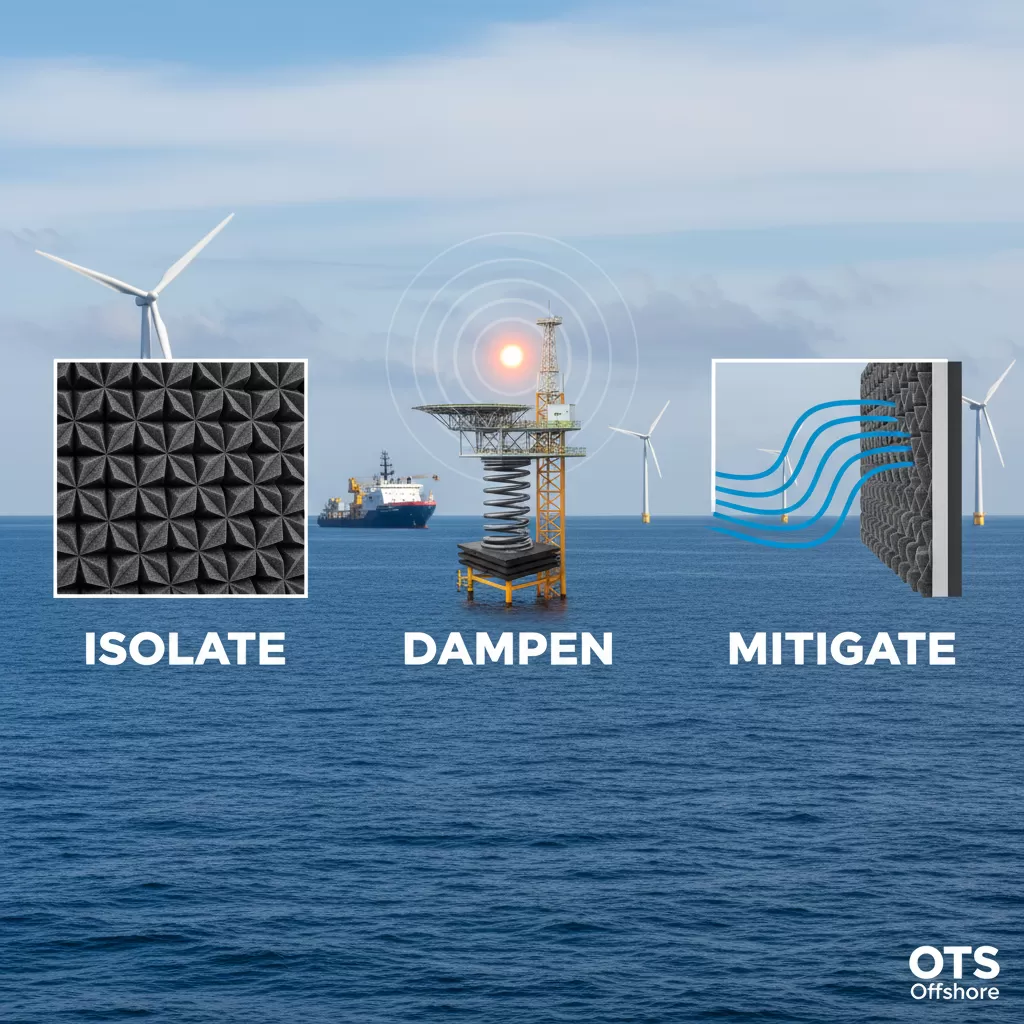
– Spring and resilient mounts: Installing machinery on carefully selected spring mounts or specialized resilient pads can decouple the equipment from the platform structure, preventing vibration from propagating. The stiffness and damping characteristics of these mounts must be precisely calculated based on the equipment’s weight and operating frequencies.
– Flexible connections: Using flexible hoses and expansion joints in piping systems can absorb vibration and prevent its transmission to surrounding structures.
– Inertial bases: For particularly heavy or problematic equipment, mounting them on massive concrete or steel bases (inertial blocks) can help to dissipate vibrational energy.
– Structural Damping and Stiffness:
– Adding damping materials: Applying constrained layer damping materials or viscoelastic coatings to vibrating surfaces can dissipate vibrational energy as heat.
– Increasing structural stiffness: Reinforcing or modifying structural elements to increase their stiffness can shift their natural frequencies away from excitation frequencies and reduce overall vibration amplitude.
– Acoustic Enclosures and Barriers:
– Sound enclosures: Housing noisy equipment within acoustically insulated enclosures is a highly effective method for reducing airborne noise. These enclosures must be carefully designed to ensure adequate ventilation while maintaining acoustic integrity.
– Acoustic barriers: Installing sound-absorbing barriers between noise sources and sensitive areas can block the direct path of sound propagation.
Receiver Control Measures
While less common in industrial settings for environmental compliance, receiver control might be considered for specific sensitive equipment or habitats, though it’s generally more applicable to human receivers.
– Noise Cancellation Technology: Active noise cancellation (ANC) systems can be employed in specific applications, though their effectiveness in the complex acoustic environments offshore can be limited.
Monitoring and Measurement for Effective Managing Vibration Noise
Robust monitoring and measurement programs are indispensable for verifying the effectiveness of Managing Vibration Noise strategies and ensuring ongoing regulatory compliance.
– Vibration Monitoring:
– Accelerometers and proximity probes: These sensors are permanently installed on critical machinery and structural elements to continuously measure vibration levels.
– Real-time analysis: Data from these sensors can be fed into condition monitoring systems, providing early detection of developing problems and enabling proactive maintenance.
– Frequency analysis: Detailed analysis of vibration spectra can identify specific sources and modes of vibration, aiding in troubleshooting.
– Noise Measurement:
– Sound level meters and microphones: These instruments are used to measure airborne sound pressure levels at various locations on the platform and in the surrounding environment.
– Hydrophones: For underwater noise assessment, specialized hydrophones are deployed to measure acoustic emissions beneath the surface.
– Acoustic propagation modeling: Sophisticated software can predict how noise will propagate through the water column and to the seabed, helping to identify areas of potential impact.
– Data Analysis and Reporting:
– Trend analysis: Tracking vibration and noise levels over time allows for the identification of gradual degradation or the impact of specific operational changes.
– Compliance reporting: Regular reports detailing measured levels against regulatory limits are essential for demonstrating compliance to authorities.
– Benchmark comparisons: Comparing noise and vibration data against industry benchmarks and best practices can identify areas for further improvement.
Challenges in Managing Vibration Noise Offshore
The offshore environment presents unique and significant challenges to effective Managing Vibration Noise.
– Harsh Environmental Conditions:
– Corrosive atmosphere: Salt spray and humidity can degrade isolation materials and fasteners, requiring careful selection of robust components.
– Extreme weather: High winds and wave action can impact measurement accuracy and the integrity of monitoring equipment.
– Limited access: Remote locations and the inherent difficulties of offshore work make maintenance and repairs more complex and costly.
– Dynamic and Complex Structures:
– Interconnected systems: Offshore platforms are complex, interconnected structures where vibration from one source can transmit and resonate through multiple components and the hull.
– Limited space: Constrained spaces on platforms often make it difficult to implement ideal isolation or enclosure solutions.
– Cost Considerations:
– High installation and maintenance costs: Implementing advanced noise and vibration control measures offshore can be significantly more expensive than onshore equivalents.
– Balancing cost and compliance: Operators must balance the investment in mitigation strategies against the potential costs of non-compliance, including fines and operational shutdowns.
Future Trends in Managing Vibration Noise Offshore
The field of Managing Vibration Noise offshore is continuously evolving, driven by technological advancements and increasingly stringent environmental regulations.
– Digitalization and AI:
– Predictive maintenance: Advanced algorithms and artificial intelligence are being used to analyze sensor data and predict potential equipment failures that could lead to increased vibration and noise, enabling proactive intervention.
– Smart monitoring systems: Integrated systems that combine real-time data acquisition, advanced analytics, and automated reporting are becoming more sophisticated.
– Material Science Innovations:
– Advanced damping materials: Development of lighter, more effective damping materials that can withstand harsh offshore conditions.
– Novel isolation technologies: Research into new methods for vibration isolation that are more compact and efficient.
– Policy and Regulatory Evolution:
– Greater emphasis on cumulative impacts: Regulators are increasingly looking at the combined effects of multiple noise and vibration sources.
– Stricter emission limits: Expectation of progressively tighter regulatory limits for noise and vibration, particularly in ecologically sensitive areas.
– Focus on Subsea Noise:
– Increased research into the impact of anthropogenic noise on marine life and development of quieter subsea technologies.
In conclusion, effective Managing Vibration Noise offshore is an intricate but vital aspect of responsible energy production. It demands a holistic, science-based approach that integrates engineering, operational best practices, and continuous monitoring. By embracing innovative technologies and adhering to rigorous regulatory standards, the offshore energy sector can mitigate its environmental footprint and ensure sustainable operations for the future.